
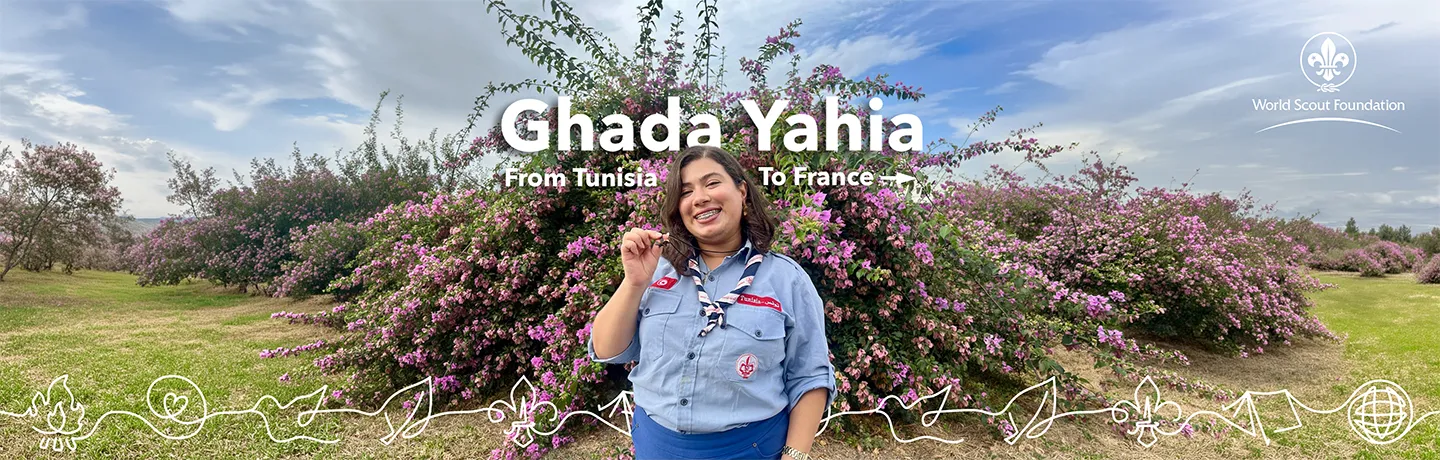
A Tunisian Scout Making an Impact in France
In a time when understanding across cultures has never been more important, we wanted to share a story that shows how Scouting builds bridges, far beyond the life of any one project. It is a story of dialogue, empathy, and the kind of leadership that brings people together -- values that continue to guide our work at the World Scout Foundation. From 2024 to 2025, the We Are The World project brought together hundreds of young people across Tunisia, equipping them with the tools to navigate cultural and religious differences through dialogue. Through workshops, exchanges, and peer-led learning, participants strengthened their ability to communicate with empathy, challenge misunderstandings, and foster mutual respect.

To understand the lasting impact of this work, we spoke with Ghada Yahia, a Scout for nearly 17 years and now a doctoral researcher and university professor in France, about how these lessons continue to shape her life.
The influence of Scouting on her journey has been profound.
What does Scouting mean to you?
Scouting has shaped me into a person who is sociable, responsible, and capable of managing both daily life and challenging situations. It taught me how to build meaningful friendships with people from different countries and cultures around the world.
Through Scouting, I became someone who approaches life with structure and purpose. I like setting goals, taking on challenges, and organizing my plans carefully. It also helped me develop resilience and confidence in facing complex situations.
For me, Scouting is not just an activity. It is truly a way of life. It is deeply connected to my love for nature, peace, and human connection. I honestly cannot imagine my life without it.

The world needs young agents of change, people who promote good communication practices, mutual respect, and openness. These are key elements in building a more peaceful and connected world."
Ghada Yahia, Tunisian Scout.
What did you learn from the We Are The World project?
I learned how to communicate effectively with people from different cultures, religions, and backgrounds while always respecting my own values and boundaries.
I learned how to express myself clearly without creating misunderstandings and how to share my own culture and beliefs in a respectful and meaningful way. The training we received was very valuable in teaching us how to communicate with sensitivity and awareness.
Today, I apply these skills in my daily life. I am currently a doctoral researcher and a university professor in France, where I work with colleagues and students from many different nationalities and cultural backgrounds.
For example, during discussions with colleagues, we sometimes talk about our traditions and beliefs. Thanks to my Scouting experience, I feel comfortable expressing myself while staying open and curious about others. I genuinely enjoy discovering differences and learning from them.
Even with my students, I try to create connection. In my first class, I shared some of my experiences to help build a sense of trust and openness among students coming from different countries.
Can you talk about a significant moment where you applied what you learned?
A meaningful moment where I applied what I learned was during an academic discussion between doctoral students from different cultural and religious backgrounds. There was a misunderstanding between a Muslim participant and a Christian Catholic participant. One of them was trying to explain a belief, but it was not expressed clearly, which created tension because it was perceived as offensive.
I stepped in to help clarify the situation. I explained to both sides that the intention was not to offend, but simply to express a different belief. I encouraged them to focus on understanding the meaning behind the words rather than reacting emotionally to how it was said.
In the end, the discussion became more respectful and constructive. This moment showed me how important communication, empathy, and cultural understanding are and how one person can help create harmony.
Why does the world need young agents of change?
In today’s world, especially in 2026, we are facing many challenges related to cultural differences, misunderstandings, and sometimes division between communities. That is why the world needs young agents of change, people who promote good communication practices, mutual respect, and openness. These are key elements in building a more peaceful and connected world. Young agents of change play a crucial role in creating bridges between cultures and helping others see diversity as a strength rather than a barrier.
If you were given a microphone and a stage in front of every Scout on earth, what message would you tell them?
Be open, be curious, and never stop learning from others. Differences are not something to fear; they are something to understand and appreciate. Always communicate with respect, stay true to your values, and use your voice to bring people together, not divide them.
Every Scout has the power to create positive change, starting with how we listen, how we speak, and how we treat others.

Ghada’s story stands on its own as a powerful reminder of what Scouting makes possible: young people equipped to engage with their worlds in relevant, positive, and impactful ways. If you feel inspired by the kind of impact she represents, the King’s Appeal offers an opportunity for you to help more young people develop these same skills, supporting projects that foster dialogue, inclusion, and peace across communities worldwide.
The King's Appeal is a time-bound, global campaign in honour of His Majesty The King of Sweden's nearly 50 years of service as Honorary Chairman of the World Scout Foundation and his 80th birthday. Your generous support will power Scout projects and initiatives that widen access to Scouting, nurture transformative youth leadership, and build peace and inclusion in communities affected by violence and exclusion.
Together, let us honour His Majesty’s remarkable legacy and fund the future of Scouting.
